Craftsmanship that lasts

20. October 2026 · Updated: 9. November 2026 · Reading Time: 2 Minutes
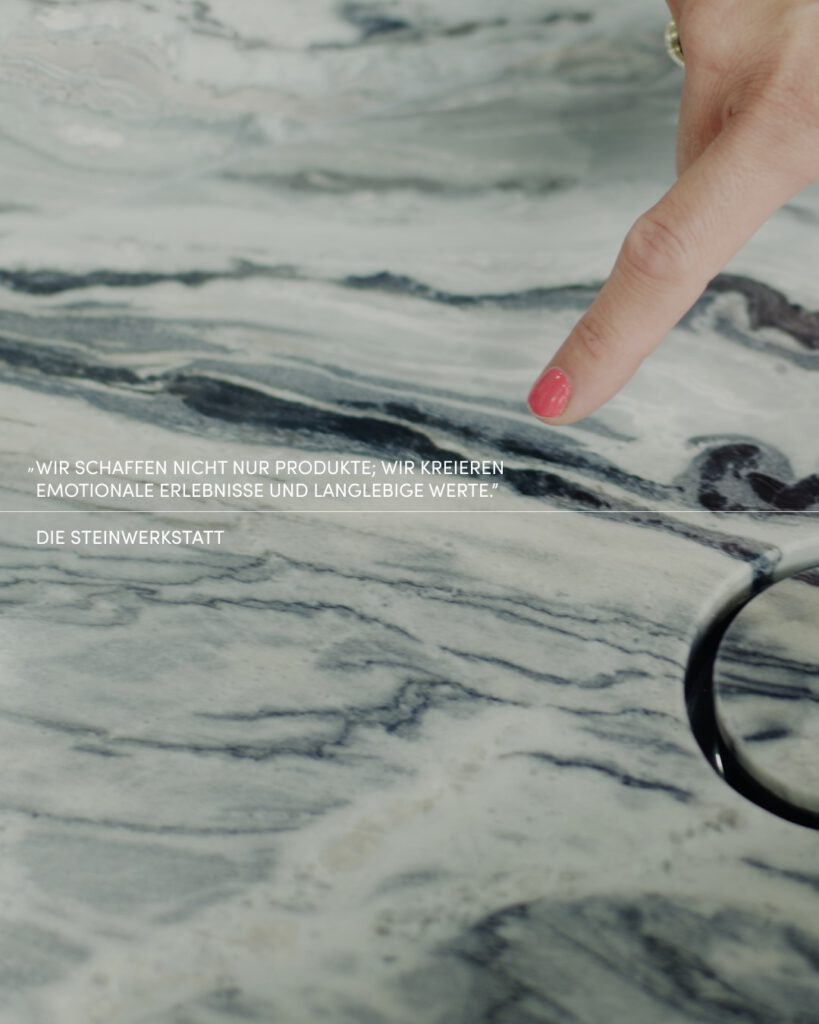
Step into the workshop in Weiler im Allgäu and the first thing you hear is the water of the saw, then for a while nothing at all. On the trestles lie slabs that formed millions of years ago and in a few weeks will become the floor of a staircase. The studio showcasing the craftsmanship involved in the process.
The Rudolph family has worked with stone for five generations. The stonemason’s business founded in 1888 has grown into DIE STEINWERKSTATT Weiler GmbH, a company for high-quality natural stone work with sites in Weiler im Allgäu and Munich. RALF SCHMITZ works with it on selected projects, currently at KISSINGER STRASSE in Berlin. A good occasion to introduce the people behind the craftsmanship of the stone.
Since 1888: five generations of stonemasonry
What began in 1888 as the Rudolph stonemasonry is still in family hands today. Over the generations, more than a business has been passed on: an understanding of how to treat a material that cannot be reordered. Every block is different, every slab has its own pattern. Those who work with it learn patience and respect.
Since 2004 the family has traded as DIE STEINWERKSTATT and has specialised in demanding natural stone work for interiors and exteriors. The founding generation’s principle remains: a piece of work is only finished when you can stand behind it. What is new are the tools, machines and planning methods that today allow a precision earlier generations could only dream of.


From block to finished surface
The work begins long before the building site, and it begins differently every time. Which stone, which finish, which format: that depends on the architecture, the location and the use, because not every natural stone suits every house. DIE STEINWERKSTATT therefore works with architects and clients to find the right approach for each project.
In villa and yacht interiors, where the company has honed its skills over many years, this often means selecting at the block. Each slab is inspected individually and planned so that its veining runs on naturally through the finished room. Here millimetres count, and any compromise shows at once.
Production takes place in the company’s own workshop: digital measurement, cutting, CNC machining, waterjet cutting, edges, surface finishes, bespoke parts. Installation is carried out by in-house teams and long-standing partner firms who know the company’s standards. Responsibility thus stays in one pair of hands from planning to the finished surface.
The range of materials extends from calm-toned limestones through classically elegant marble and local gneiss to expressive, hard-wearing quartzites.


Alongside natural stone, terrazzo is the company’s second great passion. DIE STEINWERKSTATT works with it in both forms: as terrazzo tiles, including large formats for floors and walls, and as in-situ terrazzo, which is poured, ground and polished directly on site.
Terrazzo: the supreme discipline
In-situ terrazzo is regarded as the supreme discipline of the craft. It calls for experienced terrazzo layers, a good feel for aggregate and binder, and a great deal of patience during grinding. The result is a seamless surface that gains character with every decade.

People who understand stone
Around 40 employees work in Weiler and Munich today, supported by an established network of partner firms for installation, project management and technical services. Many have been with the company for years, and some learned their trade in-house. DIE STEINWERKSTATT is a recognised training company for stonemasons.
“Only value endures.”
Guiding principle of RALF SCHMITZ
Together at Kissinger Strasse
RALF SCHMITZ has been building since 1864, likewise family-owned and likewise in its fifth generation. Its guiding principle could just as well hang above the workshop door in Weiler. Both companies think in generations, and those who think this way decide differently: in favour of material that is allowed to age with dignity, and of detail you will not regret in twenty years.
At KISSINGER STRASSE 3.4.5 in Berlin-Schmargendorf, the RALF SCHMITZ residential ensemble designed by Sebastian Treese Architekten, DIE STEINWERKSTATT is responsible for the natural stone and terrazzo work.
37 apartments, one standard: each should convey the same quality and calm. That takes precise planning, a well-practised workshop and teams who do not give away a single millimetre, even on a large site. And it takes a collaboration in which client, architect and craftspeople talk to one another early and as equals. That is exactly how DIE STEINWERKSTATT prefers to work.